








































All About Progressive No-Line Bifocal lenses
Progressive no-line bifocal lenses were originally developed to provide a more aesthetically pleasing alternative to traditional lined bifocals. By eliminating the visible dividing line, they offer a cleaner, more modern lens appearance.
Beyond aesthetics, progressive lenses are technologically advanced, seamlessly integrating multiple vision zones into a single lens. This design allows for smooth transitions between distance, intermediate, and near vision—delivering natural visual correction without abrupt image jumps. The result is a more comfortable, functional, and visually appealing solution for everyday wear.

Functionality and Design
Glasses with progressive no-line bifocal lenses represent a modern advancement in vision correction, offering a significant improvement over traditional lined bifocals. Unlike older designs, progressive lenses do not feature a visible dividing line, resulting in a smooth, seamless appearance and a more natural visual experience.
Progressive lenses are engineered to support three essential vision ranges within a single lens:
- Near vision for reading and close-up tasks
- Intermediate vision for arm’s-length activities such as computer use
- Distance vision for viewing objects farther away
What sets progressive no-line bifocals apart is their ability to integrate all three vision zones into one continuous lens design—something not typically achievable with standard single vision or traditional bifocal lenses.
In terms of structure, progressive lenses share the same functional zones as lined bifocals but differ in how these zones transition. The upper portion of the lens is optimized for distance vision, while the lower areas gradually shift to support intermediate and near vision. Instead of a hard dividing line, the transitions are blended, which can create peripheral areas of softer focus—sometimes referred to as “dead spots.” These areas are a normal characteristic of progressive lens design and become less noticeable as wearers adapt.
Multifocal Vision with Progressive Lenses
As the population ages, the prevalence of presbyopia—the natural, age-related decline in the eye’s ability to focus on close objects—continues to increase. This shift has driven major advancements in vision correction technology, with progressive lenses emerging as a leading multifocal solution.
Seamless Vision at All Distances
Progressive lenses are engineered to provide a gradual transition between multiple focal lengths, accommodating the changing visual needs that come with age. Unlike traditional bifocals or trifocals, progressives offer a smooth, uninterrupted visual experience without visible lines.
Whether you’re looking across the room, down the street, working on a computer, or reading fine print, progressive lenses deliver clear vision at every distance. Near tasks are comfortably handled by directing your gaze downward through the lower portion of the lens, while intermediate and distance viewing remain sharp and natural.
Precision Lens Design
A vertical corridor runs through the center of a progressive lens, guiding the eye smoothly from distance to near vision. Precise measurements during lens fitting ensure this corridor is optimally positioned, allowing wearers to access each vision zone comfortably and efficiently.
Reduced Image Jump
One of the major advantages of progressive lenses is the elimination of “image jump,” a common issue with bifocal and trifocal lenses. In those traditional designs, abrupt changes in lens power can cause visual disruptions when shifting focus. Progressive lenses replace these sudden transitions with a smooth, continuous change in power, resulting in a more comfortable and natural viewing experience.
Who Benefits Most
Progressive no-line bifocal lenses are commonly recommended for individuals with nearsightedness, farsightedness, and/or astigmatism. They provide a versatile, all-in-one solution for people who need correction at multiple distances.
Cost and Adaptation
While progressive lenses offer advanced functionality and a modern appearance, they are typically more expensive than single vision, bifocal, or trifocal lenses. Some wearers—especially those transitioning from lined bifocals—may require an adaptation period to become comfortable with the gradual changes in lens power.
Peripheral Vision Awareness
Progressive lenses may introduce areas of softer focus near the lens edges, which can temporarily affect peripheral vision. In some cases, this can cause mild disorientation or nausea during the adjustment phase. Most wearers adapt quickly, but individuals with highly sensitive peripheral vision may find the experience more challenging.
When Another Option May Be Better
For those who struggle with adaptation or prefer sharply defined vision zones, lined bifocal lenses may remain a suitable alternative.
Final Thought
Progressive no-line bifocals combine style, convenience, and advanced optical technology, making them an appealing choice for many wearers. However, selecting the right lens type should involve careful consideration of visual needs, lifestyle, comfort preferences, and adaptation ability.
| Feature | 🟩 Progressive No-Line Lenses | 🟦 Bifocal Lenses | 🟨 Trifocal Lenses |
|---|---|---|---|
| Visible Lines | ❌ None | ✔ One visible line | ✔ Two visible lines |
| Vision Zones | Distance • Intermediate • Near | Distance • Near | Distance • Intermediate • Near |
| Visual Transition | Smooth & gradual | Abrupt | Abrupt |
| Aesthetic Appearance | Modern & discreet | Noticeable | Very noticeable |
| Intermediate Vision (Computer) | ✔ Excellent | ❌ Limited | ✔ Defined |
| Image Jump | ❌ Eliminated | ✔ Common | ✔ Common |
| Peripheral Vision | Softer focus at edges | Stable | Stable but segmented |
| Adaptation Time | Short for most wearers | Minimal | Minimal |
| Customization Level | High (wearer-specific) | Low | Low |
| Everyday Comfort | ⭐⭐⭐⭐⭐ | ⭐⭐⭐ | ⭐⭐⭐ |
| Cost | 💲💲💲 | 💲 | 💲💲 |
| Best For | All-day, all-distance use | Reading + distance | Task-specific needs |
🎨 Color Key
🟩 Green (Progressive) → Premium, seamless, all-distance vision
🟦 Blue (Bifocal) → Simple, defined distance & near
🟨 Yellow (Trifocal) → Segmented zones with dedicated intermediate
✅ Quick Recommendation
- Choose Progressive No-Line Lenses for the most natural, modern viewing experience.
- Choose Bifocals for simplicity and minimal adaptation.
- Choose Trifocals for clearly defined zones with specific task needs.


EYEGLASSES
The reason why progressive no-line bifocals lens were created was for cosmetic purposes so people could have an appealing alternative to the traditional lined bifocal lenses. These lenses are far more technical than a standard lens.
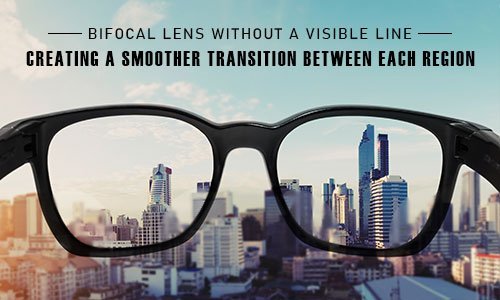
When we think of vision, there are three distinct distance ranges: near for reading or work up-close to your face, intermediate, for anything at arm’s length, and distance, for things that are farther away. Not many prescribed lenses can fix all three visions at once except for a progressive no-line bifocal lens.
A no-line bifocal lens is the modern lens that strays away from its predecessors. It is without a visible line, creating a smoother transition between each region.
The regions are like those in lined bifocals except that the edges of the lens is considered a dead spot. The top region of the lens corrects distant objects, while the bottom portion of the lens corrects intermediate and up-close objects.
A wearer may prefer bifocals without lines if they do not appreciate lined bifocal lenses; having a visible line in the lenses can be distracting to some. It can be more cosmetically appealing to wear and less strenuous on the eye. Plus, instead of owning multiple prescribed glasses, wearers can own only one pair with no-line bifocals.
Progressive lenses are recommended for people who suffer from nearsightedness, farsightedness and/or astigmatism. As much as progressive bifocals are beneficial, there are some disadvantages.
The cost of progressive lenses can be pricey compared to other lens types. There are some people who are more acquainted with a lined bifocal lens and have trouble adapting to progressive lenses. It may have an affect on the wearer’s peripheral vision at the edge of the lens which can cause people to become disoriented or nauseous. Most people will adjust to the distortion quickly and there are some who have higher sensitivity in their peripheral vision who have trouble adjusting. For people who have trouble adjusting, lined bifocals are recommended.
What is Segment Height?
Segment Height (SH) is the vertical distance between the bottom of the lens in your frame and the bifocal line on progressive lenses. The Segment Height is essential because it will determine the proportions of your lens. If you don’t have the frame you cannot know the segment height. We have standard measurements that we use for the individual frames, that seem to work very well for most customers.
If you do purchase or have a frame and are getting a progressive bifocal, you can measure your segment height by having someone measure from the bottom of the lens pocket to the center of your pupil while wearing the glasses and looking straight ahead. Segment height is measured in millimeters. Make sure to measure both eyes and give us the average between the two measurements for your segment height. Once it’s measured, you can return the frames and order the full progressive prescription glasses with your segment height. Again, we can set segment height at a standard for progressives if you’d prefer; for many people, this works perfectly.

 |  |  |