


























Types of Optical Lenses for Vision Correction
If you wear prescription glasses or readers, then your lenses refract light in a way that helps you see more clearly. (Non-prescription glasses don’t have this feature, and their lenses shouldn’t alter the quality of your eyesight.)
Here are the most common types of eyeglass lenses designed for vision correction:
SINGLE VISION LENSES

SINGLE RX
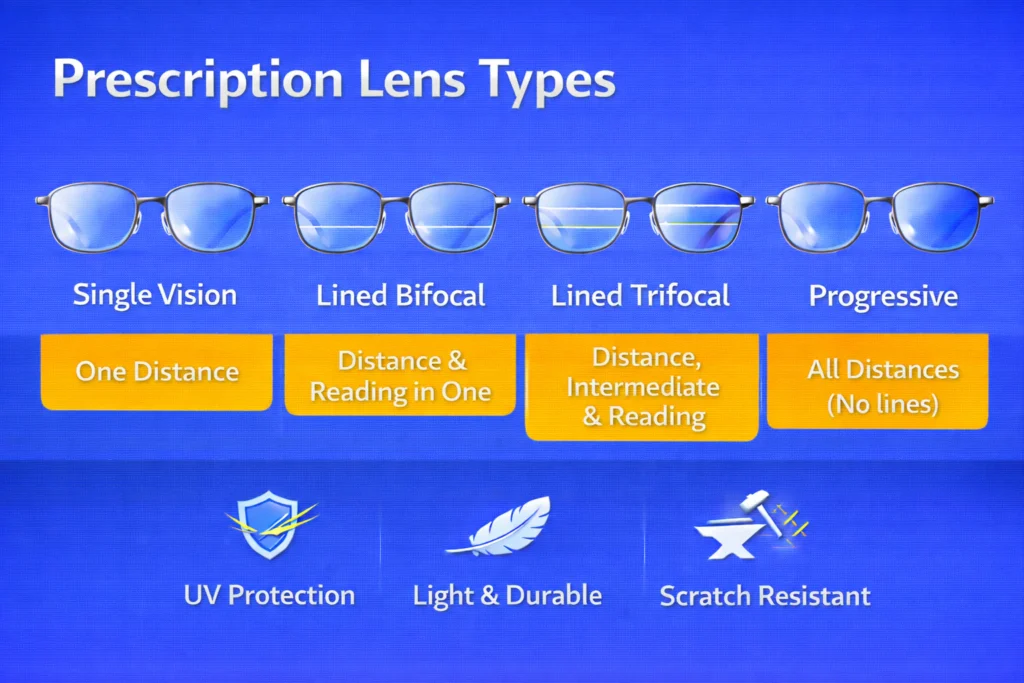
A singular lens that can improve distance or reading. With only one vision correction, this everyday lens can either correct nearsightedness or farsightedness.
A digital single vision lens is a more advanced version of a regular single vision lens, made using high-precision “freeform” technology. This process creates the lens with greater accuracy, resulting in clearer and sharper vision, especially at the edges of the lens. What makes digital lenses even better is that they are tailored specifically to your frame’s curve and size. This customization ensures that the lens fits your frame perfectly, giving you a more comfortable and personalized visual experience compared to traditional single vision lenses.
LINED BIFOCAL LENSES

MULTIFOCAL
A lens that separates near and far visions with a visible straight line. The bottom region improves close objects as the top corrects distant objects. Typically used for reading, lined bifocal lens are usually prescribed to wearers who have trouble adjusting to progressive no-line bifocal lens. The bifocal area is usually 28mm or 35mm wide.
NO-LINE PROGRESSIVE BIFOCAL LENSES

MULTIFOCAL
A bifocal lens without a visible line creating a smoother transition between each region. This bifocal lens improves vision of distant objects on the top region as the bottom improves intermediate and nearsighted visions. The no-line bifocal lens is cosmetically appealing to wear as there is no visible line.
LINED TRIFOCAL LENSES

MULTIFOCAL
The trifocal lens has three power zones separated with visible lines. Like a bifocal lens, the top and bottom regions improve farsighted and nearsighted vision as well as improve intermediate vision in the middle of the lens. The bifocal area is usually 28mm wide as the intermediate section is 7mm high.
DOUBLE D BIFOCAL LENSES

MULTIFOCAL
A bifocal lens with three separate regions separated by visible lines. The top and bottom regions improve vision of close objects while the middle region improve vision of distant objects. This lens helps reduce neck and eyestrain. The bifocal area is usually 28mm wide.
Prism Lenses
Sometimes, eyes don’t move in alignment with one another, resulting in symptoms such as double vision or eye strain. (One disorder that causes eye misalignment is strabismus, commonly known as “crossed eyes.”)
To account for this condition, your doctor may add a prism to your optical lenses. The prism is placed in a certain position and orientation based on your prescription, which will also notate the direction of the prism’s thickest edge or base. The prism correction will also have its own refractive strength, measured in prism diopters and base direction.
Spherical vs. Cylindrical Lenses
Spherical lenses correct refractive errors such as nearsightedness and farsightedness. These conditions cause light to focus in front of or behind the retina, and the lens brings its focal point back to the retina’s surface.
Cylindrical lenses are used to correct astigmatism. Astigmatism causes light to focus on multiple points within the eye, rather than just one. The shape of the cylindrical lens addresses the uneven curvature of the eye’s cornea and focuses light properly for sharper sight.
Types of Glasses Lens Materials
Lens material is a huge part of lens performance. Even though glasses lenses might look very similar to one another, they can be made from a wide variety of plastics, each of which has different properties.
You might be wondering why material matters so much. The answer is twofold: The makeup of the lens determines both its index of refraction and its Abbe value.
Index of Refraction
The index of refraction (or refractive index) of a lens tells you how quickly light moves through it, compared to how quickly it would move through a vacuum. A high refractive index means that the lens is quite good at refracting light quickly.
Determining the refractive index of a lens can look like a complex math equation involving the speed of light. However, all you need to know is that lenses with a high refractive index can be thinner than lenses with a lower refractive index while still achieving the same degree of refraction.
This is why lenses with high refractive indexes (most commonly 1.67 and 1.74) are usually recommended for people with very strong prescriptions. They pack a lot of power into a thin, convenient package.
Abbe Value
The Abbe value of a lens measures how it disperses light and therefore the likelihood that the lens will cause distortions in vision.
If a lens has a low Abbe value, you might see colorful halos around objects and lights when looking through it. These chromatic aberrations can interfere with your sight and cause a lot of distraction and irritation.
Lenses with high Abbe values, on the other hand, reduce the likelihood of these aberrations and provide clearer, uninterrupted vision.
Types of Plastic Lenses
These days, the majority of eyeglass lenses are made from plastic instead of glass. Here are the most popular plastic lens types:
CR-39 Plastic Lenses
CR-39 plastic lenses came onto the scene in the 1940s as a more affordable and less weighty alternative to glass lenses. Not only are they less liable to shatter than their predecessors, but their Abbe value is a little less than 60—the highest of any plastic lens.
However, CR-39 plastic lenses can be a bit thicker than other plastic options and typically only accommodate weaker prescriptions.
Polycarbonate Lenses
Polycarbonate lenses have a higher refractive index than CR-39 lenses, so they’re more lightweight with better refractive efficiency. Despite being easy to shape for manufacturers, they’re also quite sturdy and impact-resistant. This quality makes them extra protective for your eyes, and optometrists often recommend them for children as well as adults. They’re the reliable staple of the lens world and they come standard with all of our eyeglasses.
High-Index Lenses
High-index lenses are exactly what they sound like: plastic lenses with a high refractive index. That means they can correct more severe refractive errors without being too bulky (ours can work with prescriptions of +/-4.00 or even higher). They’re usually a bit pricier than other lens types .
Trivex Lenses
Trivex plastic lenses have a higher Abbe value than polycarbonate lenses and they weigh slightly less. However, they become thicker than polycarbonate lenses with prescriptions over approximately +/- 3.00.
Glass Lenses
If you really want to, you can still outfit your glasses with glass lenses—but just know that you’re taking a risk. The extremely clear vision that glass provides is counterbalanced by its fragility and its heaviness. If they break, glass lenses become dangerous and can cause injury to your eyes and skin. Therefore, most glasses providers no longer use this type of lens in their frames.
Types of Lens Coatings and Treatments
Once you’ve decided on your lens type and material, you can further customize your lenses with special coatings and treatments.
At VS Eyewear, we offer scratch-resistant, anti-reflective, and UV-blocking treatments with every pair of optical lenses. Other add-ons are more of a personal choice and also available.
Scratch-resistant treatment: A treatment that protects your lenses by reducing minor surface scratches and abrasions, which can be both unsightly and inconvenient. (We’re so confident in ours that we’ll replace any scratched-up prescription lenses for free if you send them back within six months of purchase.)
Anti-reflective coating: Anti-reflective coating shields your eyes from glare and other harsh reflections. It’s part of all of our optical lenses, but it’s especially essential for high-index ones, because they tend to reflect more light.
Hydrophobic coating: No one wants wet, smudgy lenses. A hydrophobic coating repels water so that your lenses stay clear and clean.
UV-blocking treatment: Blocking out UVA and UVB rays is a must for eye health. (Our lenses block 100% of both, FYI.)
Blue-light-filtering coating: If you use screens a lot (most of us do), you might want to consider blue-light-filtering lenses. These types of lenses filter out more blue light emitted by electronics than classic lenses and may help to recalibrate your sleep cycle.
Light-responsive treatment: This treatment is activated by UV light and turns your lenses into photochromic or transition lenses—meaning that they darken automatically in the sun, then go back to completely untinted when indoors. Light-responsive lenses are great for people who want to combine sunglasses and prescription glasses in one frame.
Tinted lenses: Certain glasses have tinted lenses solely for style, whereas other tinted lenses have a designated purpose, such as helping with migraine symptoms or for gaming.
Sunglasses lenses are all tinted to some degree, whether the tint is solid all across the lens or shaded in a super-cool gradient. The tint makes brightly lit environments much easier on your eyes. And as a bonus, you’ll look extremely hip.
Polarized lenses: Some sunglasses have polarized lenses, which further reduce glare and make both colors and contrasts pop in your vision. They’re great for anyone who spends a lot of time outdoors, especially around lakes and oceans.
Flash mirrored lenses: Another type of sunglasses lens, flash mirrored lenses guard your eyes against bright light and make your sunglasses look entirely reflective.
How to Find the Best Lenses for Your Glasses
When choosing the best eyeglass lenses for you, you’ll have to consider everything from your prescription and the price-point to custom coatings that suit your lifestyle.
Your eye doctor and your optician are your greatest resources. They’ll be able to provide expert recommendations. For our part, we try to make the lens-picking process an easy one while you’re shopping for glasses online or in one of our stores.
But you’re the one who will be looking through the lenses—so try them out, and see which type of lens feels like the clearest match.